
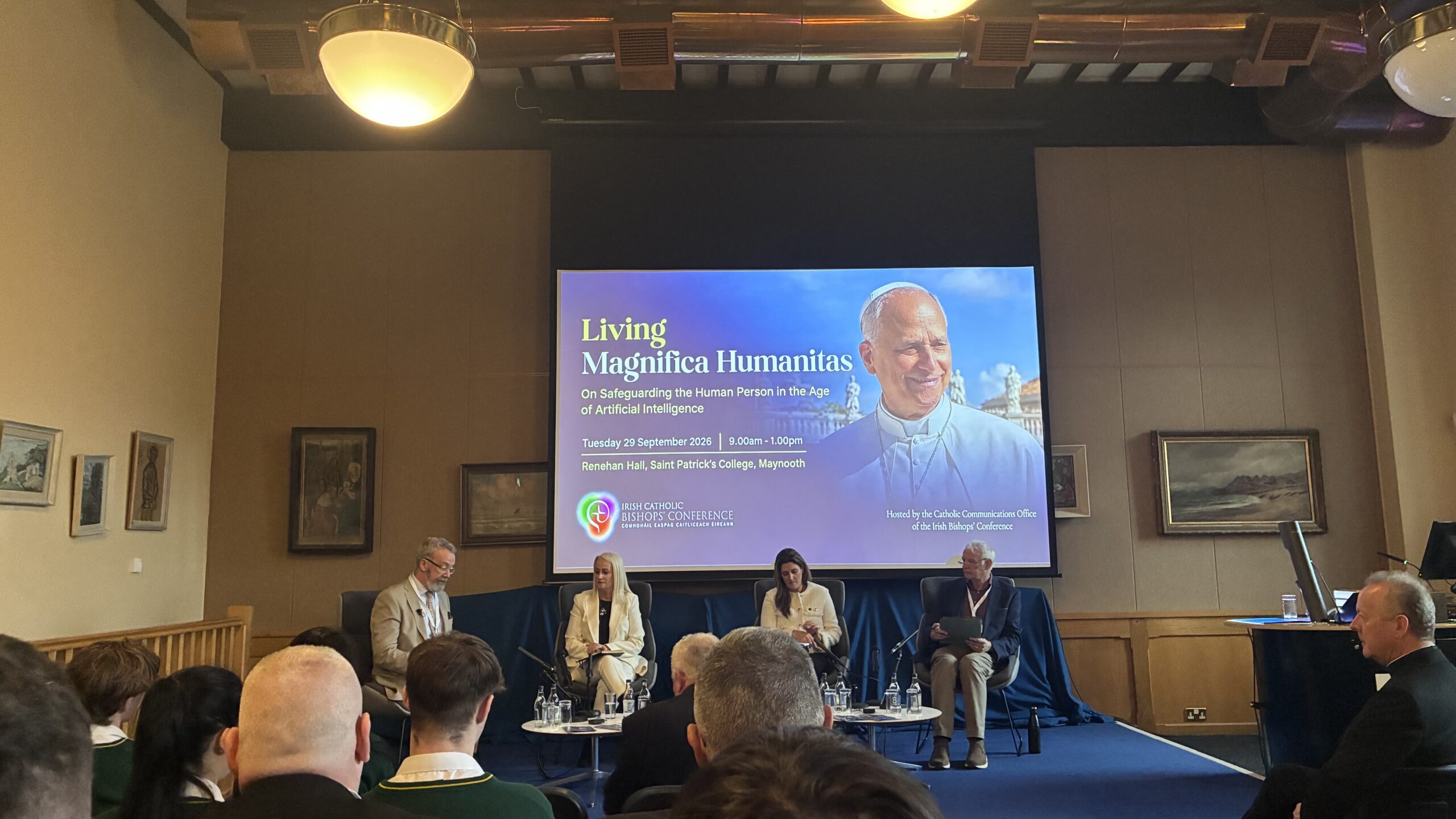
The Living Magnifica Humanitas Conference brought together people from across the Church, government, education, healthcare, technology and wider society to talk about one of the biggest issues facing us today — Artificial Intelligence (AI).The day was a chance to step back from the excitement around new technology and ask a more important question: what does all of this mean for us as human beings?The conference began with welcome remarks and an opening prayer from Mark McDonnell, a seminarian for the Diocese of Dromore, followed by hymns from the Columba Centre Choir. Archbishop Eamon Martin, Archbishop of Armagh and Primate of All Ireland, then welcomed everyone and introduced the day.
One of the main themes throughout the conference was human dignity.AI is developing incredibly quickly. It can write, create images, analyse information, answer questions and help people in many different areas of life. It is already being used in education, healthcare, business and many other parts of society.But there was an important reminder throughout the day: being intelligent is about more than processing information.People have relationships, emotions, conscience, creativity, faith and the ability to make moral decisions. A computer may be able to give us an answer, but it cannot replace the human relationship, compassion and judgement that are so important in our lives.Professor Anna Rowlands, Professor of Catholic Social Thought at Durham University, contributed to the conference, reflecting on AI, human dignity, technology, democracy and the common good.
The first panel, Opportunities and Challenges, was moderated by Alan Hynes-Cendrzak and brought together Minister Niamh Smyth, Emma Redmond and Professor Stephen Williams.It was a valuable opportunity to hear different perspectives. From government and policy to the technology industry and theology, each brought a different understanding of how AI is changing our world.There was also a video presentation from Bishop Paul Tighe, Bishop of the Diocese of Rome, who offered a wider Church perspective on the questions surrounding Artificial Intelligence and humanity.The second panel, Analysis, was moderated by Natalie Doherty and included Dr Barry Scannell, Dr Lisa Cunningham and Ciara O’Brien.Their discussion brought the conversation into everyday professional life, looking at areas such as healthcare, law, technology, media and education.
One thing that came across strongly was that AI is not simply a distant issue for the future. It is already here.In healthcare, AI can help professionals, but it cannot replace the human care given to a patient.In education, AI can be a useful tool, but students still need to learn how to think, question information and make their own judgements.In the workplace, AI may make certain tasks easier, but it also raises questions about jobs, privacy and how technology will change the way we work.The conference also looked at some of the more serious issues surrounding AI, including bias, privacy, regulation, misinformation and its use in warfare.When technology is involved in decisions that affect human life, there must always be someone willing to take responsibility for those decisions.
Perhaps one of the most interesting parts of the day was looking at AI through the Christian understanding of the human person.Magnifica Humanitas encourages us to remember that we are created, gifted, graced and limited.That is an important message in a world where technology can sometimes make us feel that everything should be faster, more efficient and more productive.Our value as human beings does not come from how much we produce, how intelligent we are or what technology we can use. Our dignity comes from who we are.This also means that technological progress does not automatically mean human progress. Something can be faster and more efficient, but we still need to ask whether it is good, fair and respectful of people.
The conference also highlighted the importance of having an open and inclusive conversation about AI.This cannot be a conversation left only to governments, technology companies or academics. Ordinary people, families, young people, workers, educators, healthcare professionals and communities all have a part to play.We need to understand AI, but we also need to be able to question it.The day finished with a strong sense that this conversation is only beginning. There are no simple answers to many of the questions being raised, but there is a need for continued dialogue, reflection and discernment.The Living Magnifica Humanitas Conference brought together a wide range of voices, including Archbishop Eamon Martin, Bishop Paul Tighe, Professor Anna Rowlands, Minister Niamh Smyth, Emma Redmond, Professor Stephen Williams, Alan Hynes-Cendrzak, Mark McDonnell, Natalie Doherty, Dr Lisa Cunningham, Dr Barry Scannell and Ciara O’Brien, as well as everyone who attended and contributed to the discussions.Ultimately, the conference was not simply about Artificial Intelligence.
It was about us — our dignity, our responsibility, our relationships and the kind of future we want to create.As technology continues to move forward, the challenge is to make sure that we do not lose sight of what makes us human.Technology can be a powerful tool, but it should always remain at the service of the human person and the common good.